
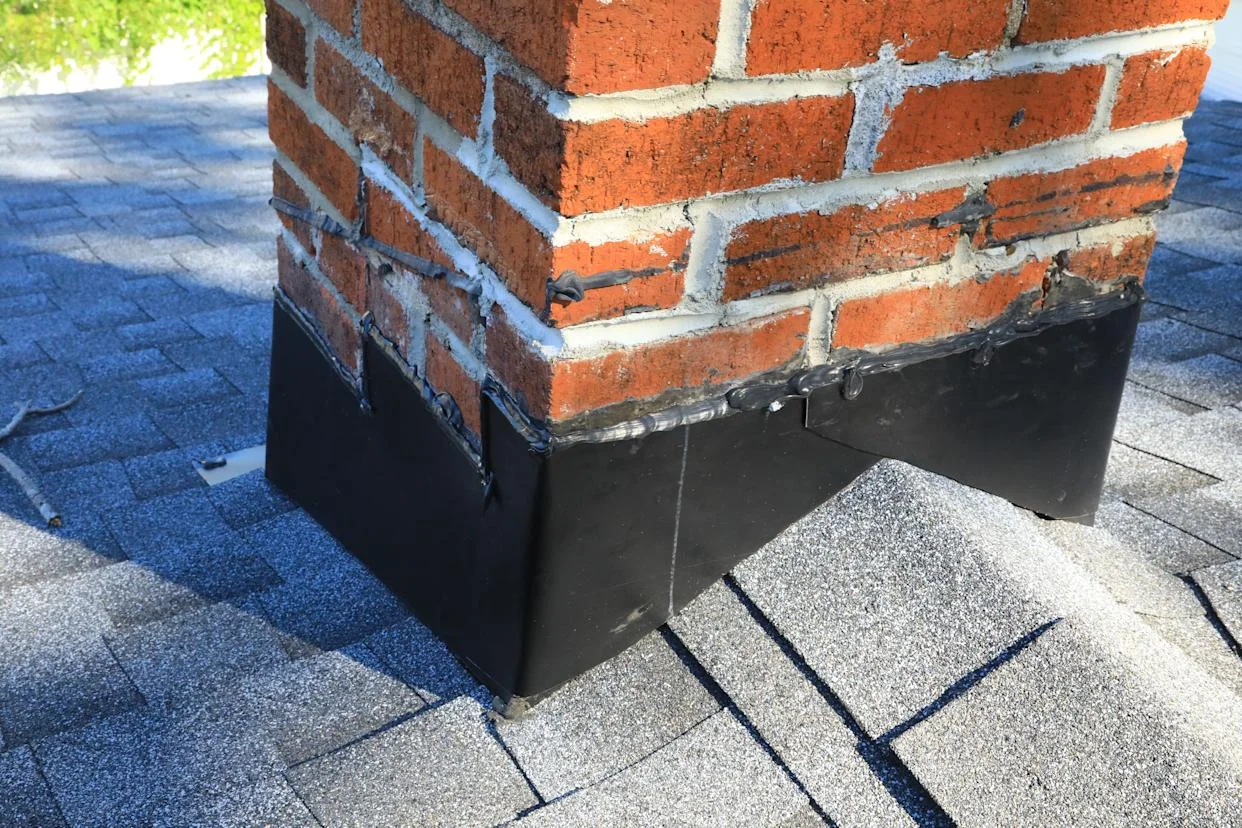
Quick Answer: Is a Chimney Cricket Required in Georgia? Yes, in many cases. Georgia code requires a chimney cricket when the chimney is over 30 inches wide parallel to the ridgeline. The chimney must also not sit on the ridge. Since January 1, 2026, Georgia homes follow the 2024 IRC with Georgia amendments.
Water is patient. After every Georgia thunderstorm, it sits behind your chimney and looks for a way into your home. A chimney cricket is the simple roof feature that stops it.
Georgia adopted a new residential building code on January 1, 2026. This guide from Archer Chimneys & Exteriors in Newnan explains exactly when code requires a chimney cricket.
What You'll Learn
- What a chimney cricket is and how it protects your roof
- Which building code applies to Georgia homes in 2026
- The 30-inch rule and how to measure your own chimney
- How tall a cricket must be for your roof pitch
- Flashing, materials, and metal roof considerations
- What installation costs and what drives the price
What Is a Chimney Cricket?
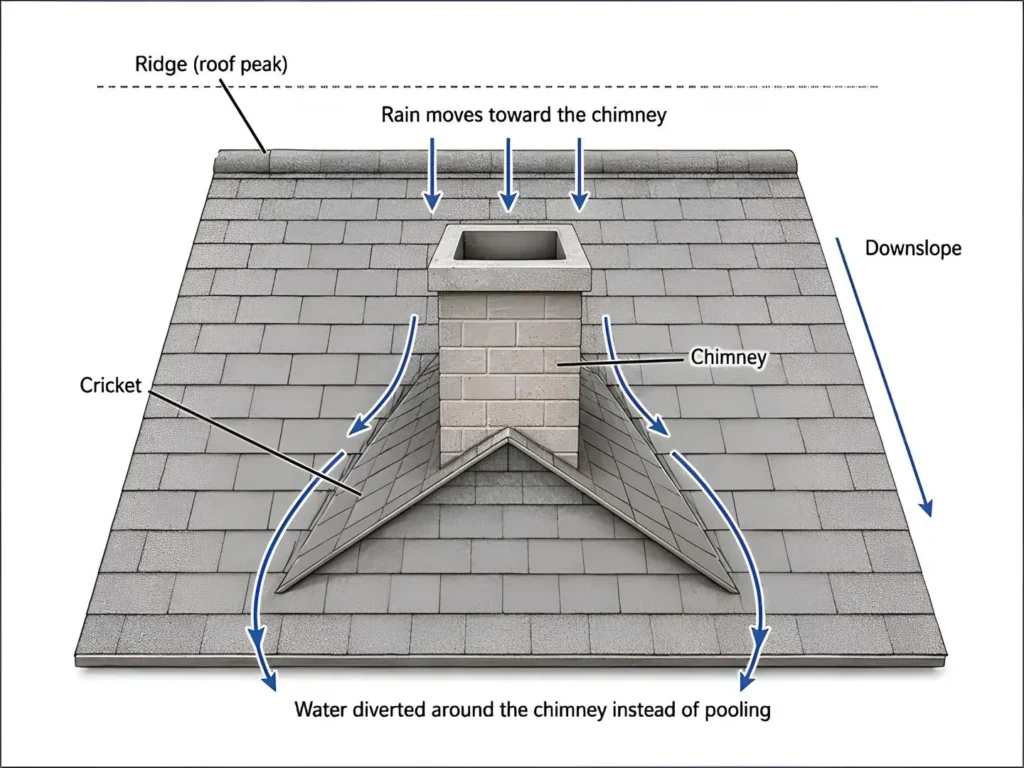
A chimney cricket is a small, peaked structure built into the roof behind a chimney. It sits on the uphill side, facing the ridge. Some roofers call it a saddle. Think of it as a tiny roof with two sides. Rain hits the peak, splits left and right, and flows around the chimney.
Without a cricket, the back of a wide chimney acts like a dam. Rainwater, leaves, and pine needles collect in that pocket.
That trapped moisture causes three main problems:
- Flashing wears out and lifts faster than anywhere else on the roof.
- Roof decking behind the chimney begins to rot.
- Water eventually reaches the attic and stains ceilings.
Cricket vs. Saddle vs. Diverter
- Cricket: The common name for the triangular, ridge-shaped structure behind a chimney.
- Saddle: The same structure under another name. Codes often say “crickets and saddles” together.
- Diverter: A small bent strip of metal that redirects some water. It does not replace a code-required cricket.
Which Building Code Applies in Georgia in 2026?
Georgia sets statewide minimum building codes through the Department of Community Affairs (DCA). As of January 1, 2026, homes follow the 2024 International Residential Code (IRC) with 2026 Georgia Amendments.
Before that date, Georgia used the 2018 IRC. Here is what the switch means for chimney cricket rules:
- The cricket requirement comes from the base IRC itself.
- It has been part of the residential code for many editions.
- The 2026 update did not create it.
- We are not aware of a Georgia amendment that removes it.
Local enforcement still matters. Confirm current requirements with your local building department, such as the City of Newnan or Coweta County.
Clearing Up a Common Myth
Many national cost websites say the International Building Code (IBC) requires crickets only on chimneys built after 2012. That claim has two problems.
- Wrong code: Georgia houses fall under the IRC, not the IBC. The IBC covers commercial buildings.
- Wrong date: The 30-inch cricket rule appeared in residential code books well before 2012. Inspectors were quoting it as far back as 2005.
The 30-Inch Rule: When Georgia Code Requires a Chimney Cricket
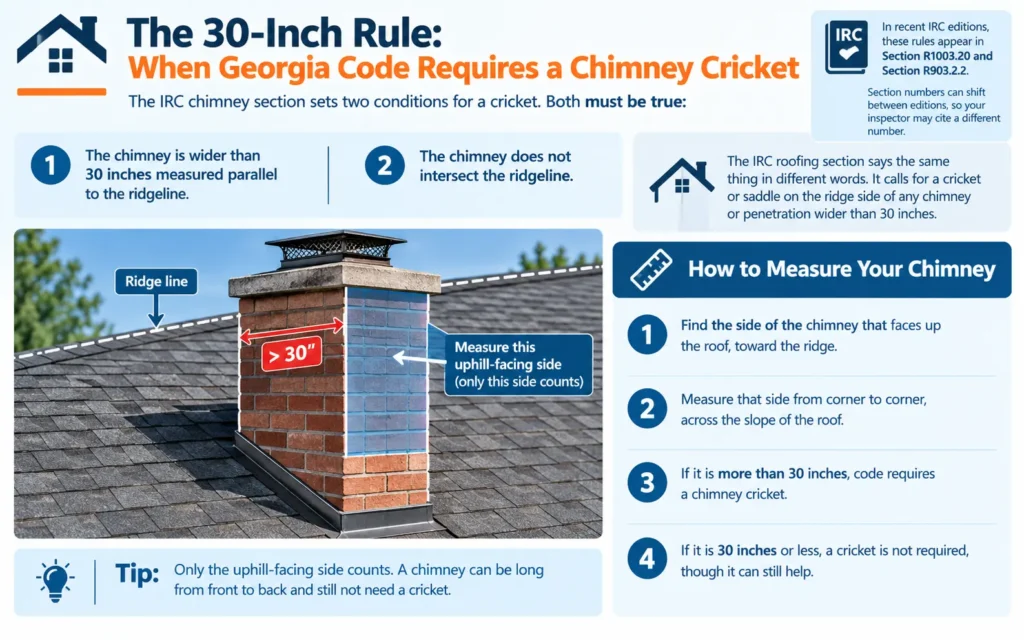
The IRC chimney section sets two conditions for a cricket. Both must be true:
- The chimney is wider than 30 inches measured parallel to the ridgeline.
- The chimney does not intersect the ridgeline.
The IRC roofing section says the same thing in different words. It calls for a cricket or saddle on the ridge side of any chimney or penetration wider than 30 inches.
In recent IRC editions, these rules appear in Section R1003.20 and Section R903.2.2. Section numbers can shift between editions, so your inspector may cite a different number.
How to Measure Your Chimney
- Find the side of the chimney that faces up the roof, toward the ridge.
- Measure that side from corner to corner, across the slope of the roof.
- If it is more than 30 inches, code requires a chimney cricket.
- If it is 30 inches or less, a cricket is not required, though it can still help.
Tip: Only the uphill-facing side counts. A chimney can be long from front to back and still not need a cricket.
When a Cricket Is Not Required
- The chimney’s uphill face is 30 inches wide or less.
- The chimney sits on the ridge, so water already sheds away on both sides.
Does the Rule Apply to My Existing Home?
Building codes mainly apply to new construction and permitted work. An older home without a cricket is usually not in violation simply because it is old.
However, three situations bring the question up fast:
- Roof replacement: A permitted reroof is the most common time a missing cricket gets addressed.
- Home sale: Home inspectors often flag a missing cricket on wide chimneys.
- Active leaks: If water gets in behind the chimney, a missing cricket is often the root cause.
How Tall Must a Chimney Cricket Be?
The code ties cricket height to your roof pitch. A steeper roof needs a taller cricket. The height is a fraction of the chimney’s width.
Roof Pitch | Minimum Cricket Height | Example: 48-Inch-Wide Chimney |
12:12 | 1/2 of chimney width | 24 inches |
08:12 | 1/3 of chimney width | 16 inches |
06:12 | 1/4 of chimney width | 12 inches |
04:12 | 1/6 of chimney width | 8 inches |
03:12 | 1/8 of chimney width | 6 inches |
A cricket that is too short is a common installation mistake. It creates a flat “dead valley” behind the chimney.
Water then gets pushed into the corners. Those corners are the weakest points of the flashing.
Chimney Cricket Flashing: Where Most Leaks Start
A cricket only works if the flashing around it is right. Code requires the cricket-to-chimney joint to be flashed and counterflashed like any roof-to-chimney connection.
The Flashing Layers in a Proper Installation
- Ice and water shield: A self-sealing membrane applied over the cricket and valleys before roofing goes on.
- Valley flashing: Metal lining the two valleys where the cricket meets the main roof.
- Step flashing: L-shaped metal pieces woven in with each shingle course along the chimney sides.
- Cricket (back pan) flashing: Metal covering the joint where the cricket meets the back of the chimney.
- Counterflashing: Metal set into the chimney’s mortar joints, overlapping the step flashing from above.
- Apron flashing: A single metal piece across the front, downhill face of the chimney.
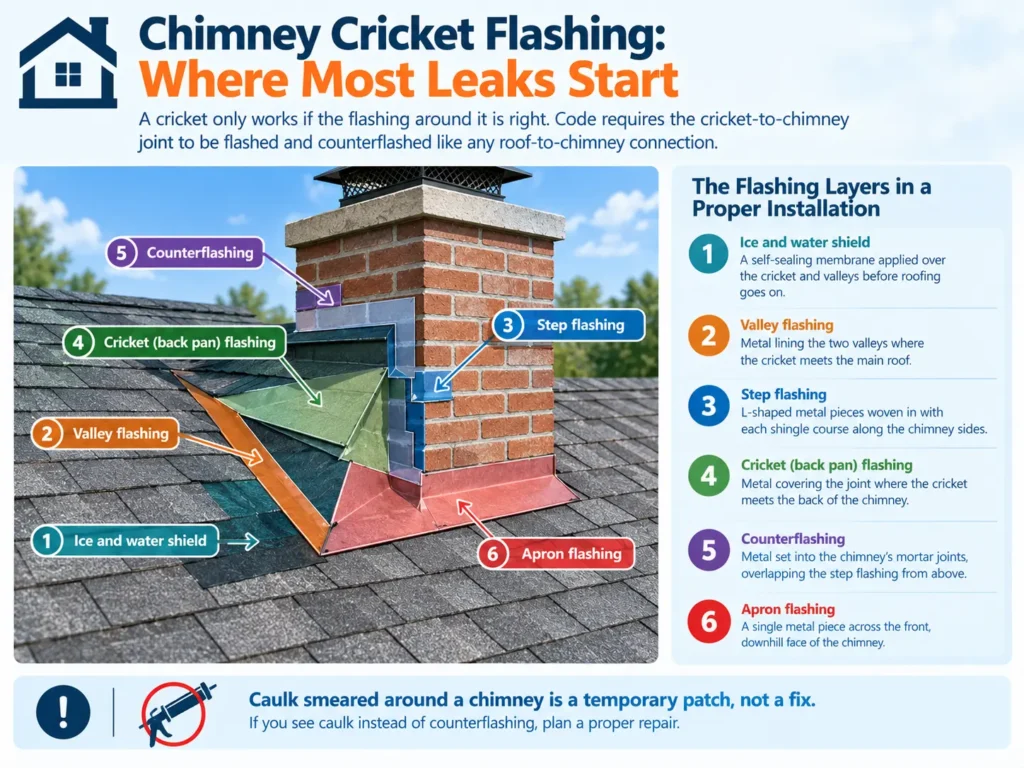
Caulk smeared around a chimney is a temporary patch, not a fix. If you see caulk instead of counterflashing, plan a proper repair.
Chimney Cricket Materials, Including Metal Roofs
Wood-Framed and Shingled
This is the most common option on asphalt shingle roofs in the Newnan area. The cricket is framed with lumber, sheathed with plywood or OSB, and shingled to match.
It blends in with the roof and usually costs less than custom metal.
Sheet Metal Crickets
- Galvanized steel: Durable and budget-friendly. It works well when painted to match the roof.
- Aluminum: Lightweight and rust-resistant. It needs careful detailing where it meets masonry.
- Copper: The premium choice. Soldered copper can last for decades and develops a natural patina.
Metal Roof Chimney Cricket
On standing seam or metal panel roofs, the cricket is usually built from the same metal as the roof. Mixing dissimilar metals can cause galvanic corrosion over time.
Metal panels also expand and contract in Georgia’s summer heat. The cricket and its flashing must allow for that movement, so experience matters.
Chimney Cricket Installation: Step by Step
- Inspect and measure. Check chimney width, roof pitch, masonry condition, and existing flashing.
- Remove roofing. Strip shingles and old flashing from the area behind the chimney.
- Frame the cricket. Build a ridge and supporting framing to the height the code table requires.
- Sheath and seal. Add plywood or OSB, then cover it with ice and water shield.
- Install flashing. Set valley, step, and cricket flashing in the correct overlapping order.
- Roof the cricket. Apply shingles or metal to match the rest of the roof.
- Counterflash the chimney. Cut mortar joints, set counterflashing, and seal it properly.
- Test and inspect. Water-test the area and complete any required permit inspection.
Chimney Cricket Installation Cost and Price Factors
Published national price guides vary widely. Angi lists cricket installation at about $150 to $500. Thompson Creek notes that steep roofs, very wide chimneys, or premium materials can push the cost as high as $5,500.
Why the big gap? The low end usually reflects adding a cricket while the roof is already open. The high end reflects standalone retrofits with repairs, copper, or difficult access.
What Affects Your Price
- Chimney width: Wider chimneys need bigger crickets and more flashing.
- Roof pitch: Steeper roofs need taller crickets and more safety equipment.
- Material: Shingled crickets cost less than copper or custom metal.
- Timing: Adding a cricket during a roof replacement saves labor.
- Hidden damage: Rotted decking or failed masonry must be repaired first.
- Permits: Some projects require a local permit and inspection.
Money-saving tip: If your roof is near the end of its life, add the cricket during replacement. Always ask for an itemized quote.
Why Choose Archer Chimneys & Exteriors
Archer Chimneys & Exteriors is a licensed, insured, family-owned chimney and exterior services company. We are based in Newnan, GA, and serve homeowners throughout Coweta County, Marietta, and Asheville, NC.
Here is what separates us from general contractors and national chains:
- Full leak diagnosis. We assess every potential entry point on every visit. You get a complete diagnosis, not a partial fix.
- Level 2 video camera inspections: We inspect the interior of your flue from the crown to the firebox. We identify damage that is invisible from the outside.
- Chimney and roofing expertise combined: Since chimney leaks often involve both the chimney and the roof, our dual expertise removes the guesswork about where the water originates.
- Licensed and insured: We carry full licensing and liability coverage across all service areas.
- 279+ verified Google reviews: Our reputation is built on honest inspections and accurate repairs for homeowners throughout the Newnan area.
- Inspection fee applied to repairs: Your inspection fee counts toward any repair or service within 30 days. You are paying for real answers.
Conclusion: Protect the Weakest Spot on Your Roof
Georgia homes follow the 2024 IRC as of 2026. Code requires a cricket when your chimney’s uphill face exceeds 30 inches and does not touch the ridge.
The cricket’s height depends on roof pitch, and proper flashing keeps it watertight. Stains near your chimney or caulk in place of flashing are worth a closer look.
For more updates, expert tips, and customer reviews, follow us on Facebook and Instagram, or visit our Google Business Profile to see why homeowners trust us.
Contact us today to schedule your inspection or get a free quote.
Frequently Asked Questions About Chimney Crickets
What is a chimney cricket?
It is a small, peaked roof structure built behind a chimney on the uphill side. It splits rain and debris so water flows around the chimney instead of pooling against it.
Is a chimney cricket required in Georgia?
Yes, when the chimney is wider than 30 inches parallel to the ridgeline and does not sit on the ridge. Georgia follows the 2024 IRC with 2026 Georgia Amendments.
Which code section covers chimney crickets?
The IRC covers crickets in its chimney section, R1003.20, and its roofing section, R903.2.2. Numbering can shift between code editions, so check with your local building department.
Which side of the chimney do I measure for the 30-inch rule?
Measure the side that faces up the roof, toward the ridge. Measure it corner to corner, across the slope. Only that uphill face counts toward the 30-inch rule.
Does my older home need a chimney cricket?
An older home is usually not in violation just because it lacks a cricket. However, a cricket often gets addressed during a permitted roof replacement, a home sale, or a leak repair.